
How the CIA and Israel Pulled Off the Successful Opening Leadership Strike on Iran

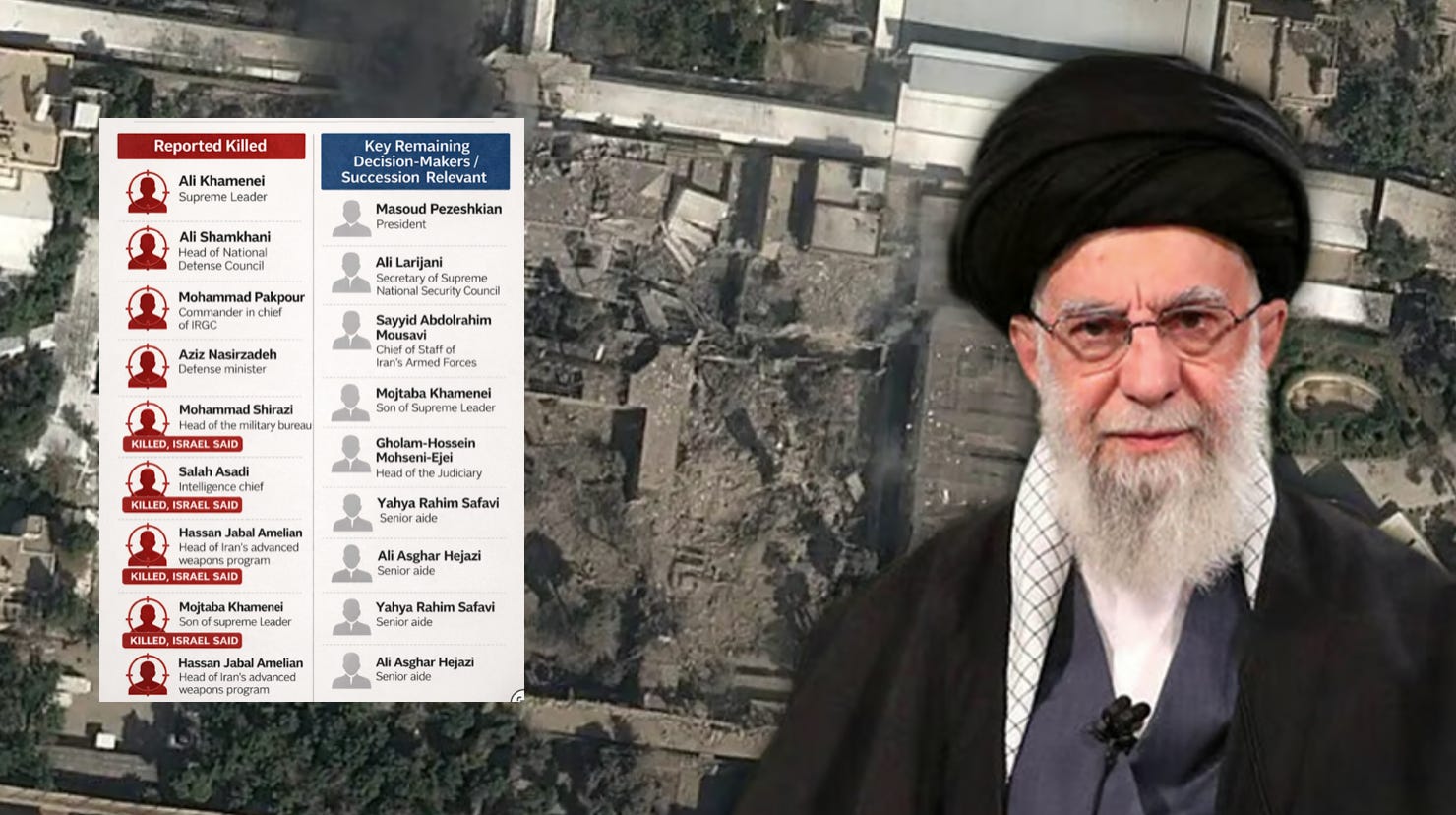
Questions continue to swirl around the wisdom and legality of Trump’s war on Iran, but just for this post, let’s strip all that away for a moment and look at the opening move purely as an intelligence-and-targeting problem: how did the US and Israel manage to hit senior Iranian leadership so fast, so hard, and (apparently) so precisely? As a former CIA officer I’m curious — and appreciate a well-designed and executed operation when I see one. Intelligence and military personnel deserve credit where credit is due — and it seems to be due here.
Let’s take a deeper look.
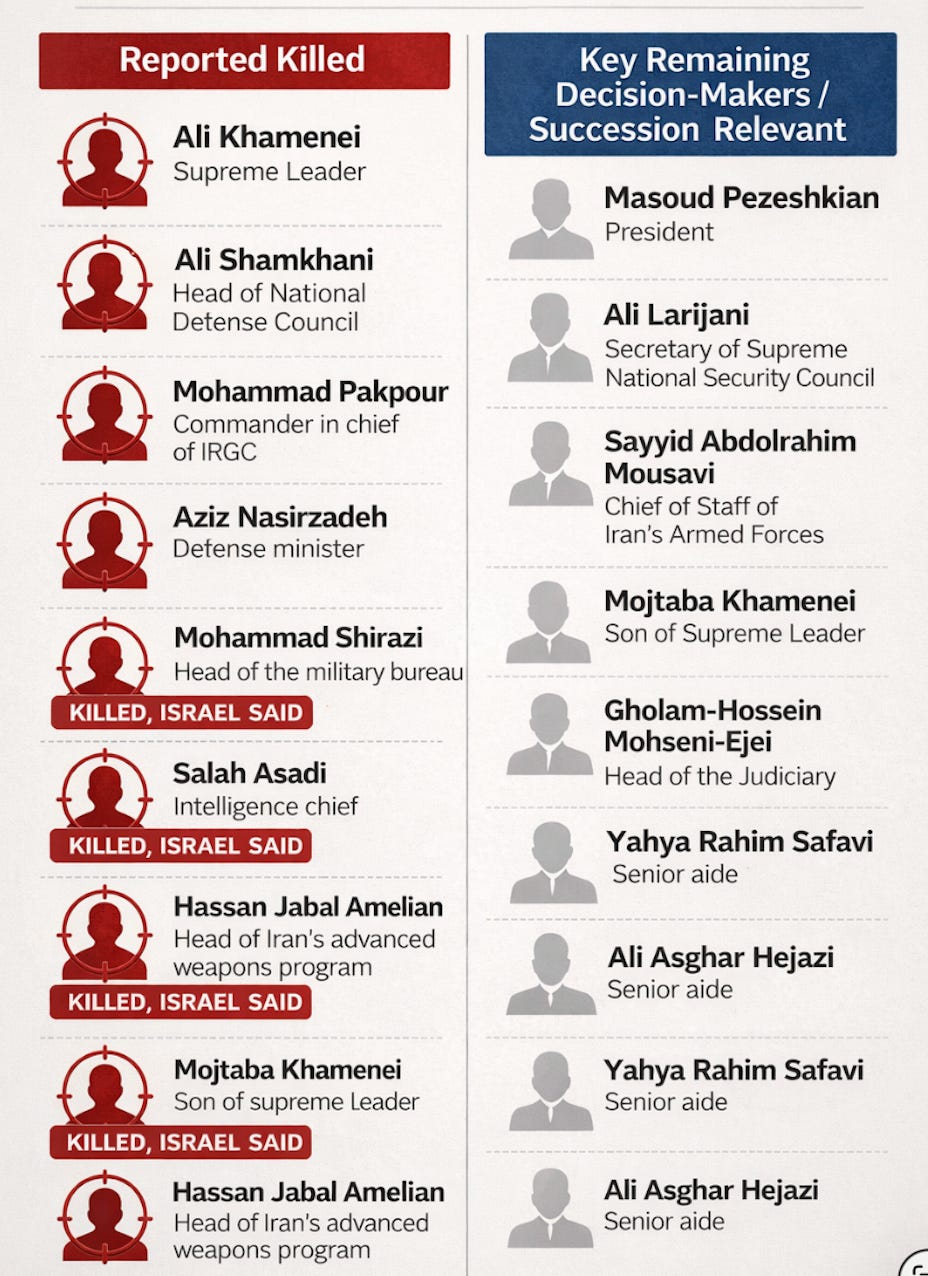
Apart From Khameni, Which Top Leaders Were Killed?
Here is what we know so far from all sources, with a fairly high degree of confidence:
What we can say with some confidence about what unfolded
The clearest operational timeline so far comes from the NY Times, with specific times and a clear sequence.
According to the Times, Israel’s operation began around 6:00 a.m. Israel time, with fighter jets taking off carrying long-range, highly accurate munitions. (6:00 a.m. Israeli time is 7:30 Teheran time so we’ll stay on Teheran time from here on.)
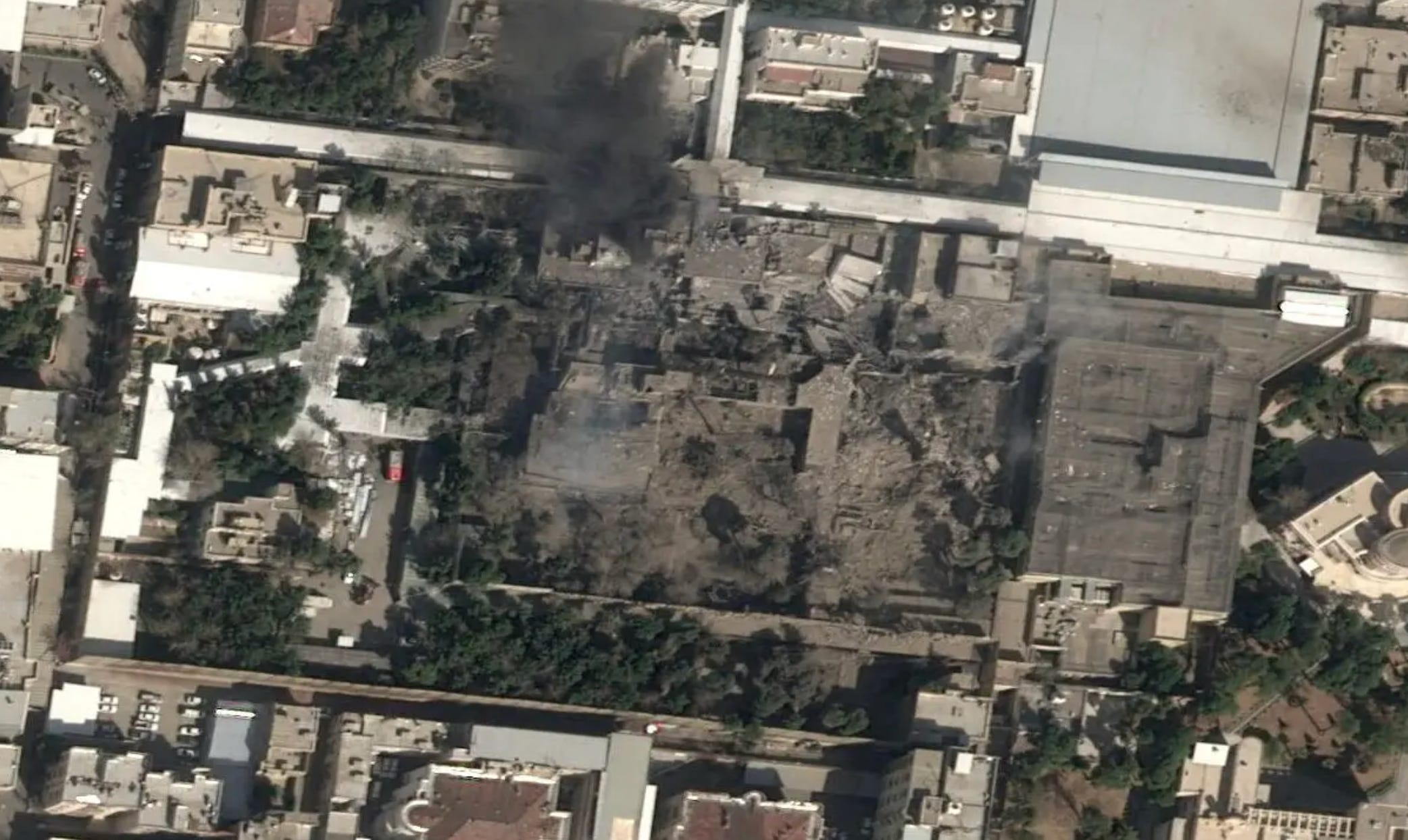
Two hours and five minutes later long-range missiles were released and struck the leadership compound where the senior officials were meeting in Tehran around 9:40 a.m. Tehran time.
At the moment of impact, senior Iranian national security officials were reportedly in one building on the compound, while Ayatollah Khamenei was in another nearby building. So this was not a single “residence” target, but a compound-level strike with multiple aimpoints.
An Israeli defense official, in a message reviewed by the Times, described the morning strike as being carried out simultaneously at several locations in Tehran, including a location where senior political-security figures had gathered—adding that Israel achieved “tactical surprise.”
That’s the basic cinematic outline: takeoff, long transit, weapons away, timed impacts on a leadership complex.
The key operational pivot: a Saturday morning convergence
The Times reports that the U.S. and Israel originally planned to strike at night, under cover of darkness, but adjusted the timing to take advantage of a Saturday morning gathering of senior Iranian officials at a leadership compound in Tehran.
This is the part that explains the audacity of the daytime clockwork.
Night strikes are the default for obvious reasons: surprise, survivability, confusion. Shifting away from that suggests planners believed the Saturday morning convergence was more valuable than darkness itself.
The reporting also says the CIA had been tracking Khamenei for months and learned that top Iranian officials would be meeting Saturday morning at the compound—and that Khamenei would be there.
That “everyone’s in the room” moment is what turns a complex leadership-targeting problem into a solvable one.
What Reuters adds: the plan was accelerated
Reuters adds the most important wrinkle: the operation was accelerated after Israeli intelligence detected the meeting earlier than anticipated.
That phrase matters because it implies the strike wasn’t merely “planned,” it was sitting in a posture where it could be moved forward quickly once the window appeared sooner—or was confirmed sooner—than expected.
The public reporting does not fully explain what “earlier than anticipated” means in practice. It could mean the meeting was expected later in the day. It could mean the meeting’s confirmation arrived earlier. It could mean the meeting was moved up internally and was caught in time.
But the operational concept is clear enough: the target’s schedule dictated the strike’s schedule, and the strike package could move fast.
What the strike design hints at
The public details, limited as they are, still tell a story:
Standoff lethality. “Long-range” and “highly accurate” weapons strongly suggest a strike designed to be executed without hanging around over Tehran.
Compound choreography. The “one building / nearby building” detail suggests multiple aimpoints inside a secured complex, not a single “hit this one dot” mission.
Simultaneity. The Israeli claim of multiple Tehran locations struck at once points to an opening wave designed to disorient and overwhelm.
That combination—tight timing, high confidence in target presence, multiple aimpoints, simultaneous locations—is how modern decapitation-style opening moves look when they work.
How they got “close enough” — and why the leadership hit probably had to come first
This was a strike that moved fast and appears to have preserved tactical surprise to the moment of impact: jets airborne around 7:30 a.m. Teheran time, and long-range missiles hitting a leadership compound in Tehran around 9:40 a.m. Tehran time. An Israeli defense official said strikes were carried out simultaneously at several locations in Tehran and achieved “tactical surprise.”
So how do you get “close enough” to hit the political heart of Tehran without giving the game away?
First, “long-range, highly accurate munitions” suggests the aircraft may not have needed to penetrate Iranian airspace at all. In modern strike doctrine, the aircraft often only needs to reach a release point; the weapon does the risky part. That reframes “undetected.” The goal isn’t necessarily invisibility. It’s compressing Iran’s reaction window so detection and response come too late.
Second, while the public record doesn’t confirm it, it would be unsurprising if the package included electronic warfare and deception—jamming, spoofing, decoys, cyber effects—anything that slows the defender’s ability to see, decide, and act in real time. Surprise against a prepared defender usually has help.
Finally, the leadership question: was this the first weapons contact? If anything significant had hit earlier, leadership could have dispersed and the Saturday meeting advantage would have evaporated. The emphasis on simultaneity and “tactical surprise” fits a planning concept where the leadership strike was either the first impacts of the war—or tightly synchronized with the first impacts—so the targets were still in place when the weapons arrived.
The question I can’t answer
Knowing that war was truly imminent and likely to start at any moment; knowing US and Israeli capabilities both in terms of weaponry and intelligence — why in the world did the Iranians decide to bring everyone physically together in a relatively unprotected urban setting anything less than a bomb proof bunker? This is a gift to the Israelis and Americans that I just can’t quite fathom.
But credit where credit is due—CIA did its part, and the Israelis did their part. I don’t have to agree with the politcal or strategic decisions by leadership to be able to give a tip of the hat to the operators who who pulled it off flawlessly. This was an impressive operation.
I hope you found this one interesting — even if it’s not addressing the urgent political and strategic questions. We’ll get back to that. As always, if you’re finding this reporting helpful and you can swing $60/year or $6/month to help keep it going and growing — your support means a lot. And if you can’t do that, no worries — just don’t forget to like, comment, restack, share. All of that helps too.