
The German Ace Who Understood "Out of Combat" And Honored It
A historical study in contrast to the "second strike" saga engulfing Washington

The story of the Stigler-Brown encounter, which I have summarized below, is true. It caught my attention as I was scanning for historical stories that have relevance to the Hegseth/Bradley “second strike” saga unfolding today. Sources are listed at the end. Enjoy.
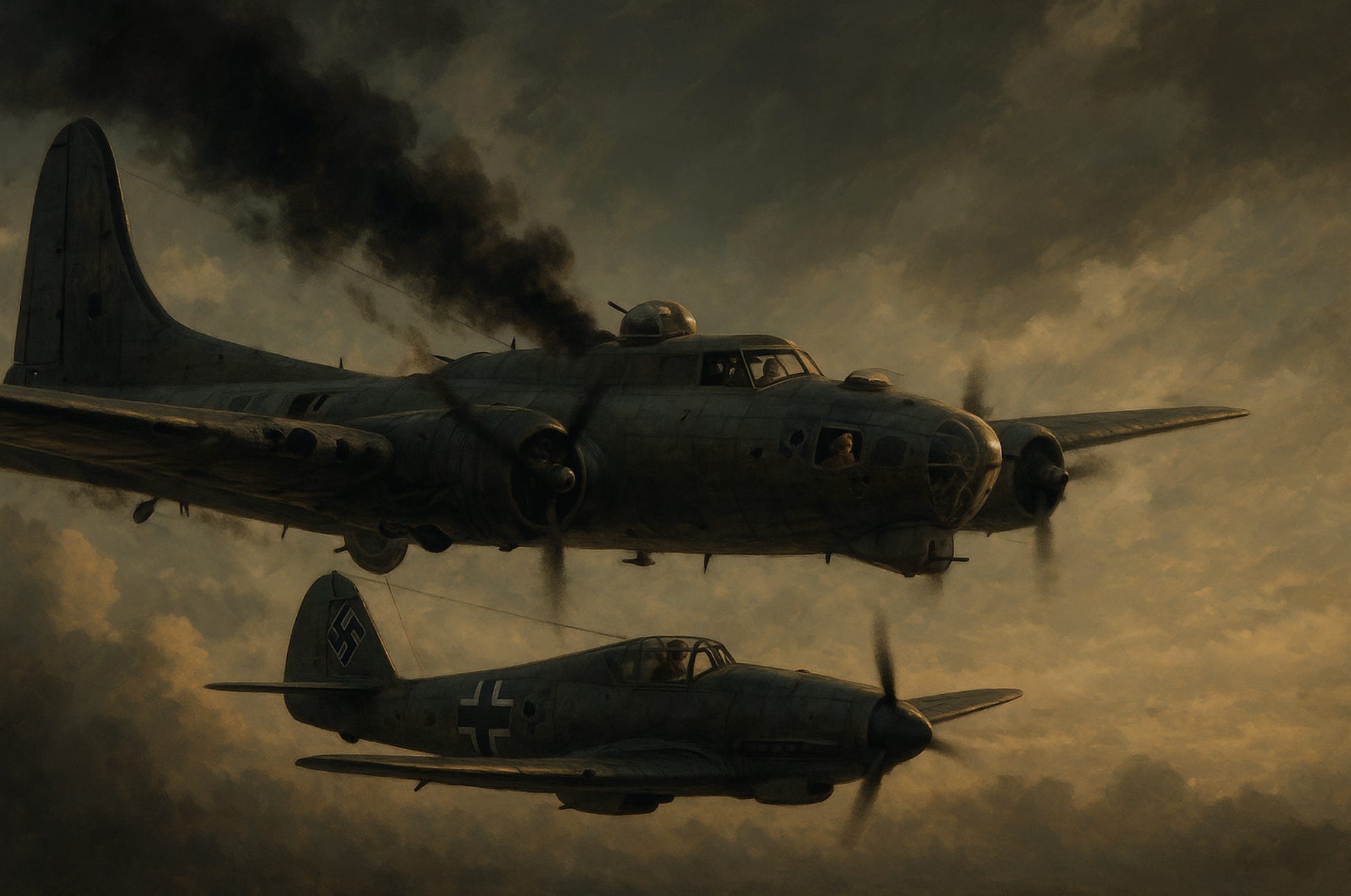
Twenty thousand feet above Germany, on a freezing December morning in 1943, a young American pilot named Charlie Brown found himself flying a ghost of an airplane.
His B-17, Ye Olde Pub, had been hammered by flak and shredded by fighters.
The nose was blown open.
The engines were sputtering.
The fuselage looked gnawed by an animal.
Blood had frozen on the tail gun where the gunner — barely out of high school — lay dead.
Brown, only 21 years old, was fighting to keep the bomber aloft with one hand; the other was numb and useless from shrapnel. His crew — those still alive — drifted in and out of consciousness, deep in the terrible quiet that follows violence. They were no longer combatants. They were surviving out of sheer will.
And then Brown saw it:
A Messerschmitt Bf 109 sliding into formation off his wing.
The German fighter could have ended them with a single burst. Brown braced for it. Everyone did.
But the attack never came.
The German pilot — Franz Stigler, one victory away from earning the Knight’s Cross — held his fire. He edged his fighter so close that Brown could see his face: calm, focused, unmistakably human.
Stigler had been a professional killer that morning. He had already downed another bomber. He was trained to finish the wounded, to erase anything limping home to fight again. But what he saw inside the B-17 was not a target.
It was a massacre waiting to happen.
Bleeding boys.
Unconscious airmen.
A dead tail gunner hanging motionless in the cold wind.
Later, Stigler would say:
“To shoot them would have been murder. They were clearly out of combat.”
He was thinking of something his commander, Gustav Rödel, had once told him:
“If I ever see you shoot a man in a parachute, I will shoot you myself.”
There were rules. Not written, not always followed — but rules of honor that lived in the souls of certain men even in Hitler’s Luftwaffe.
So instead of killing the bomber, Stigler flew beside it, shielding it, waving Brown onward. When German gunners on the coast began tracking the crippled plane, Stigler maneuvered deliberately, making it clear the B-17 was his escort.
He guided the bomber all the way to the North Sea — far enough that Brown could limp toward England.
Then, as the ocean wind rushed over the wings, Stigler did something Brown would never forget:
He saluted.
A crisp, formal salute — pilot to pilot, man to man.
And then the German peeled away, disappearing into the gray winter sky.
The Search
For decades, Brown told no one. The story sounded like myth, and he assumed no one would believe it. But he could not stop thinking about the German who had spared him — the stranger who had looked into his cockpit and seen not an enemy but a human being.
In the late 1970s, Brown began searching. He wrote letters, contacted veteran organizations, published inquiries. Nothing. There was no record of a German fighter escorting an American bomber.
Some suggested he imagined it — oxygen deprivation, trauma, the haze of battle.
But Brown knew what he had seen. And he kept looking.
Then, in 1990, a response finally reached him.
A former Luftwaffe pilot living in Canada had read Brown’s inquiry and came forward.
His name was Franz Stigler.
The Reunion
Brown called him. His voice trembled.
“I think you were the one who saved my life,” he said.
There was a long pause. Then, softly, Stigler replied:
“You were the B-17 with the dying tail gunner.”
He remembered every detail.
Weeks later, they met in person. Two old men now — both grandfathers, both with the weight of war in their eyes. They embraced like family.
Stigler confessed he had never told anyone, not even his wife. In Nazi Germany, sparing an enemy could have meant execution.
He carried the memory alone for 47 years.
Brown introduced him to friends as “the man who saved my life.”
Stigler would say simply,
“He was just a boy.”
For the rest of their lives, they were inseparable — speaking at schools, traveling together, demonstrating that even in a war built on dehumanization, one man had chosen compassion.
Charlie Brown died in 2008.
Franz Stigler followed eight months later, as if unwilling to outlive the bond formed in that frozen sky.
How We Know It Happened
This story is unusually well-documented for wartime lore. The core events have been authenticated through:
U.S. and German mission records
Interviews with both men recorded in the 1980s and 1990s
Independent Luftwaffe archives confirming Stigler’s sortie that day
Air Force combat damage reports from the battered B-17
Eyewitness accounts from surviving crew
Adam Makos’s meticulously researched book A Higher Call, based on direct interviews and archival material
Obituaries published in The New York Times, Los Angeles Times, and others
There is no doubt the incident occurred.
What remains remarkable is why it occurred.
A Final Note
I’m thinking tonight about Franz Stigler’s decision — the moment he looked at a helpless enemy crew and concluded that firing would not be war, but murder. And I’m contrasting it with what we have learned thus far abou the ‘second strike’ video seen by top Senators, and the testimony of Admiral Frank M. Bradley. Remarkably, Bradley acknowledged that they watched for more than an hour as the two survivors clung to the broken hull. He admitted he saw no evidence that they had any means to communicate with anyone, nor did they have any means to guide or to propel the boat anywhere. Yet he claims that he and those operating that day judged it to be a continuing threat .
Obviously, one Luftwaffe pilot’s act of chivalry and compassion does nothing to undo the Nazi atrocities of World War II.
But it illuminates something about the human spirit, doesn’t it?
I wonder what Hegseth and Bradley would think of Stigler’s decision.
Different century, different ocean, different actors —
But the moment of decision is the same.
And it still matters.
Thank you for letting me share some ancient history. We can learn from it.
War History Online
https://www.warhistoryonline.com/war-articles/64443.html
Wikipedia
https://en.wikipedia.org/wiki/Charlie_Brown_and_Franz_Stigler_incident
WarHistory.org
https://warhistory.org/fr/@msw/article/charlie-brown-and-franz-stigler-incident
Franz Stigler Obituary
https://www.legacy.com/us/obituaries/legacyremembers/franz-stigler-obituary?id=45968270
A Higher Call Wikipedia
https://en.wikipedia.org/wiki/A_Higher_Call
A Higher Call Amazon
https://www.amazon.com/A-Higher-Call-Adam-Makos-audiobook/dp/B00BH59WVK/ref=sr_1_1?crid=2KNZ4T6V5L5WL&dib=eyJ2IjoiMSJ9.m6xdlQhMlo44ApC3f2B1cEW1T7ZE0L8TLy03ToxjU3v7Afm7O12uEzWx_Oifchu0g3bQuwad_eRmcKT_RZkOmDB5SADbKeb0WC1xzTzAj-LCFAIZHrO5eGDo1HOBeSANm75ll9P01gS_AoevbuO_qr2CrKbj34GN2jnnFKlfCPSRWHIqIrRSLODc7DtD83xtzEBBZMdRIEpe1_IimpSq0ZTwym9ZBlQrB4Swywo4UZs._-wk7JGIttIHXynzz_2BJuT00k8zwq9sV0iQcg059N8&dib_tag=se&keywords=a+higher+call&qid=1764911249&sprefix=a+higher+call%2Caps%2C180&sr=8-1
Air and Space Forces Magazine
https://www.airandspaceforces.com/article/valor-when-an-enemy-was-a-friend/