
Intel Assessment: Something May Be Happening in Moscow. Here Is What We Know.

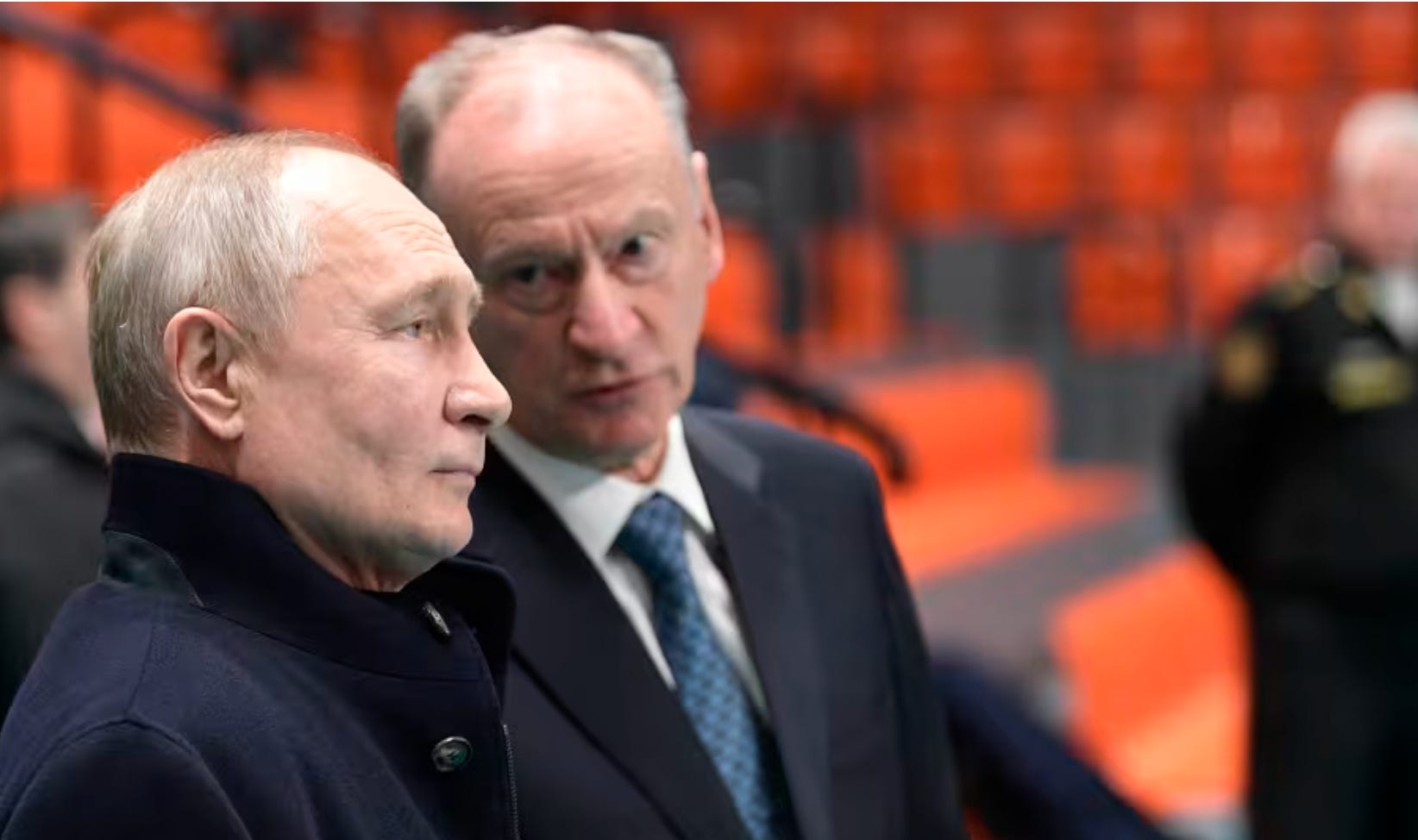
Four years into the war with Ukraine, there are always rumors flying around Moscow about possible leadership changes. That is almost a permanent feature of Russian politics. The system is opaque by design; consequential decisions are made behind closed doors; rival factions leak against one another; and the Telegram ecosystem routinely mixes genuine inside information with speculation, factional warfare, disinformation, wishful thinking and outright nonsense.
So caution is always indicated, especially when the subject is Vladimir Putin. He has survived for more than a quarter-century at the center of Russian power. He is extraordinarily experienced, deeply entrenched, institutionally protected and famously adept at balancing competing factions against one another. Rumors of his impending removal, illness, collapse or political demise have circulated repeatedly over the years, and most have amounted to nothing.
There is, however, a point at which the usual Moscow rumor swirl crosses a threshold and becomes something worth paying serious attention to. I believe we may have reached that threshold.
In a nutshell, the new reporting is that a major reshuffle may be underway inside the Russian security establishment: longtime FSB chief Alexander Bortnikov would move to run the Security Council; his first deputy, Sergei Korolev, would take over the FSB; Sergei Shoigu would be removed and possibly arrested; and Vladimir Putin would be pushed into retirement as power shifts toward a group associated with former Security Council chief Nikolai Patrushev.
The most explosive element of the reporting is that this would not be a transition fully or perhaps even partially controlled by Putin. The suggestion is that events may have moved beyond his ability to stop them.
That is an extraordinary claim, and it is not established fact. But enough surrounding it can now be independently identified that the matter deserves a careful look.
The task, then, is to separate what is genuinely known from what is newly reported, and to separate both from what remains speculation.
What Is Genuinely Established
The first point is that this story did not suddenly materialize out of thin air.
A specific personnel scenario involving some of the same central figures was already circulating in Russian political and security circles for weeks. The basic version was this: Alexander Bortnikov, who has headed the FSB for 18 years since 2008, could leave that position and move to the Security Council, while Sergei Korolev, currently Bortnikov’s powerful first deputy, could replace him as director of the FSB.
Both moves are institutionally plausible. Bortnikov is one of the most senior figures in the Russian security establishment, while Korolev is already positioned immediately beneath him and has long been regarded as a plausible successor. This is a recognizable succession scenario inside the system itself and it makes good sense to any informed observer.
There is also a genuine question hanging over Sergei Shoigu. Shoigu was removed as defense minister and shifted to the Security Council after years as one of the most visible figures in Putin’s government. Since then, a broad purge of figures associated with his former Defense Ministry apparatus has kept alive persistent questions about his own position. None of that establishes that Shoigu is about to be arrested, but it does mean that speculation about his vulnerability did not begin this morning.
Putin also held an “operational meeting” of Russia’s Security Council on Friday. The meeting itself is not suspicious. Putin holds such sessions ot infrequently, and the Kremlin often releases only minimal information about what was discussed. Still, it adds another piece to the chronology at a moment when personnel speculation involving the Security Council and the FSB was already circulating.
So before reaching the dramatic part, several things can be said with reasonable confidence. There is real discussion of a potential Bortnikov-Korolev reshuffle. There is a real question about Shoigu’s future. And there is real attention focused on the institutions that matter most in any Russian leadership transition: the Security Council and the FSB.
None of that proves that Putin is being removed. It does, however, create the background against which the new reporting has to be evaluated.
How the New Reporting Builds on This
The new reporting takes the existing personnel scenario and expands it into something much larger.
Instead of a relatively conventional reshuffle in which Bortnikov moves to the Security Council and Korolev takes over the FSB, the emerging scenario is this:
Patrushev has assembled—or is in the process of assembling—a coalition within the Russian security establishment with enough institutional power to make moves that Putin may no longer be able to block or control.
Bortnikov will move to the Security Council
Korolev will take control of the FSB
Shoigu will be arrested; and Putin will be forced into retirement.
Most importantly, the transition is said to be beyond Putin’s control.
That changes the meaning of everything else. A president reorganizing his own security team is one thing. A president being presented with a new power arrangement that he can no longer prevent is something fundamentally different. The distinction is between a reshuffle and a transfer of power.
At the moment, the new reporting remains unconfirmed. But it is more difficult to dismiss than the average Moscow rumor for several reasons.
The first is specificity. The report does not merely say that “something big” is happening. It names the principal figures, describes the proposed movement of power, identifies who gains, identifies who loses and makes predictions that should, in principle, become observable.
The second is that it builds directly on a personnel scenario that was already circulating independently. That can be interpreted in two very different ways. The skeptical interpretation is that an ordinary Kremlin rumor has simply been embellished as it moved through intelligence and political circles. That happens all the time. The more significant interpretation is that the earlier personnel rumor represented only the visible edge of a larger process already underway.
At this point, there is no reliable way to know which interpretation is correct. That is precisely why the report merits attention rather than either instant belief or instant dismissal.
The third difference is provenance. The more dramatic reporting appears to be circulating beyond the usual public Telegram ecosystem and through intelligence-connected channels. That does not make it true. Intelligence services receive false reports; sources misunderstand events; rival factions deliberately seed stories; and raw intelligence is often fragmentary and contradictory. But there is still an important distinction between an anonymous Telegram post announcing that Putin is finished and information about a specific leadership transition reportedly being tracked through intelligence channels.
The latter remains unconfirmed. It nevertheless belongs in a different analytical category.
What the New Reporting Would Mean
If the broader scenario is accurate, this would not be a normal Kremlin reshuffle. It would represent a fundamental change in the balance of power inside the Russian state.
The alleged configuration is particularly significant because of who the central figures are. Nikolai Patrushev is not simply another former official. He was director of the FSB before Bortnikov and then served for sixteen years as secretary of the Security Council. He is one of the central figures in the security-service network that has surrounded Putin for decades.
Bortnikov represents the current leadership of the FSB. Korolev represents institutional continuity inside the FSB. Taken together, the reported alignment suggests not an uprising from outside the regime, but a possible movement from deep inside its own security core.
That is what makes the phrase “Patrushev’s group” important. The claim is not necessarily that Patrushev himself would become president. It is that the coalition around him would control the transition.
In a system like Russia’s, the formal officeholder and the real center of power do not necessarily have to be the same person. A successor could emerge through formally constitutional mechanisms while the actual terms of the transition were dictated by the security establishment.
Putin could even announce his own retirement, appear publicly, sign decrees and describe the transition as voluntary. None of those things, by themselves, would settle the underlying question of whether the decision was really his.
The central analytical question is therefore not simply whether Putin might resign. It is whether he would still have the ability to refuse.
If the answer is no, then whatever the Kremlin eventually chose to call the process, we would be looking at something much closer to a palace coup than an ordinary succession.
Why Shoigu May Be the Key Indicator
The most consequential near-term prediction may be the claim that Sergei Shoigu will be arrested.
A simple personnel move would not necessarily tell us very much. Shoigu could be replaced as secretary of the Security Council and the Kremlin could plausibly present that as another round of elite rotation.
An arrest would be something else entirely.
Shoigu is a former defense minister, the current secretary of the Security Council and one of the most recognizable members of Putin’s ruling establishment. Arresting him would not look like bureaucratic rearrangement. It would look like a purge.
The sequence would matter as much as the event itself. If Putin were to announce a retirement and Shoigu later fell from grace, that could still be consistent with a managed transition. If Shoigu were detained first, Bortnikov then moved into the Security Council, Korolev took control of the FSB and Putin subsequently “retired,” the interpretation would become much darker.
In that sequence, the formal announcement would look less like the beginning of the transition than its final public presentation.
What to Look For
The advantage of a report this specific is that it should be testable.
The first and most obvious indicator is Shoigu. Does he continue functioning normally as secretary of the Security Council? Does he make public appearances? Does he suddenly disappear from view? Is there any sign of investigation, detention or removal?
The second is Bortnikov. Does he remain at the FSB, or do leaks and official moves begin pointing toward a transfer to the Security Council?
The third is Korolev. Does he suddenly become more visible? Is he elevated? Does Russian state media begin preparing the ground for him as the next FSB director?
Putin’s own public activity will also matter, although perhaps less straightforwardly than it might appear. A clearly live appearance in which he is visibly exercising authority would weigh against the most dramatic versions of the reporting. It would not necessarily disprove an internal power struggle, but it would be significant. By contrast, prerecorded footage, photographs, written statements or appearances of uncertain timing would tell us much less.
The Security Council itself also bears watching. Are there further meetings? Who attends them? Does Patrushev suddenly assume a more prominent role? Does Shoigu disappear from the institutional picture?
And then there is the wider coercive apparatus. Any genuine effort to force a Russian president from power would ultimately depend on more than the FSB alone. The positions of Rosgvardia, the presidential protection apparatus, the military leadership and the presidential administration would all matter. If the reported process is real, additional signs of alignment should eventually become visible.
Final Assessment
The responsible conclusion at this point is not that Vladimir Putin has been overthrown. There is not enough evidence for that. Nor is there enough evidence to say that a coup is definitely underway.
But neither do I think this can be dismissed as just another random Moscow rumor.
The threshold for serious attention has been crossed for several reasons. There is a real and independently circulating personnel scenario involving Bortnikov and Korolev. The new reporting expands that scenario in a highly specific and internally coherent direction. And the central claims are concrete enough that events should begin either validating or discrediting them.
The most important claims remain the least confirmed: that Patrushev has convened a group capable of dictating the transition, that Shoigu is to be arrested and that Putin has lost the ability to control what comes next.
Those are extraordinary claims, and they require extraordinary caution. But they are now specific enough, and connected to enough independently visible movement inside the Russian security establishment, that they deserve close attention.
For now, my assessment is deliberately narrow: something significant may be developing inside the Russian leadership. There is not yet enough evidence to say exactly what it is. But there is enough evidence to watch very carefully.
And in a system as opaque as Putin’s Russia, that may be the most responsible place to begin.
MS Note: I know this one takes us pretty deeply down into the weeds of the inner machinations of Kremlin politics. I hope I’ve been able to untangle it enough for it to make coherent sense. The bottom line is that thing is that there more than the usual “rumblings” coming out of the Kremlin—enough of an increase that it warrants a deeper look, and that’s what I’ve tried to provide in a sober, ‘intel assessment’ way. Thank you for supporting this process. Your support matters and I thank you for it
Audio listeners can stop here.
Sources
https://www.kremlin.ru/events/president/news/80268
https://www.kremlin.ru/events/security-council
https://www.interfax.ru/russia/1102469
https://www.interfax.ru/russia/1102476
https://www.kommersant.ru/doc/8812671
https://tgstat.ru/en/channel/%40rucriminalinfo_2
https://www.svoboda.org/a/zashevelilisj-patrushev-protiv-shoygu/33782941.html
https://www.svoboda.org/a/33771239.html
A note on sourcing: the central claims that Patrushev has assembled a coalition capable of acting beyond Putin’s control, Shoigu will be arrested, and Putin will be forced into retirement remain unconfirmed reporting from a confidential source and are not established by the public sources above. The public sources support the surrounding factual context: the July 10 Security Council meeting; the independently circulating Bortnikov-to-Security-Council/Korolev-to-FSB scenario; and the broader evidence of tension surrounding Shoigu and Patrushev.
Really appreciate your analysis… especially when you are dissecting intelligence. Russia analysis is clearly a forte! I wonder what a shift like that would mean for 1) US relations and 2) Ukraine . Obviously a guess, but seems they could both be dramatically different.
Wow, Michael, this is a most interesting post and your analysis is like reading a spy novel! You really have a talent for creating succinct and easily understood narrative. THANK YOU, so much!!