
Furious Ukrainians Protest Sacking of Tech Innovator Defense Minister Mykhailo Fedorov

There are moments in international politics when the event itself is less important than the public’s reaction to it.
This strikes me as one of those moments.
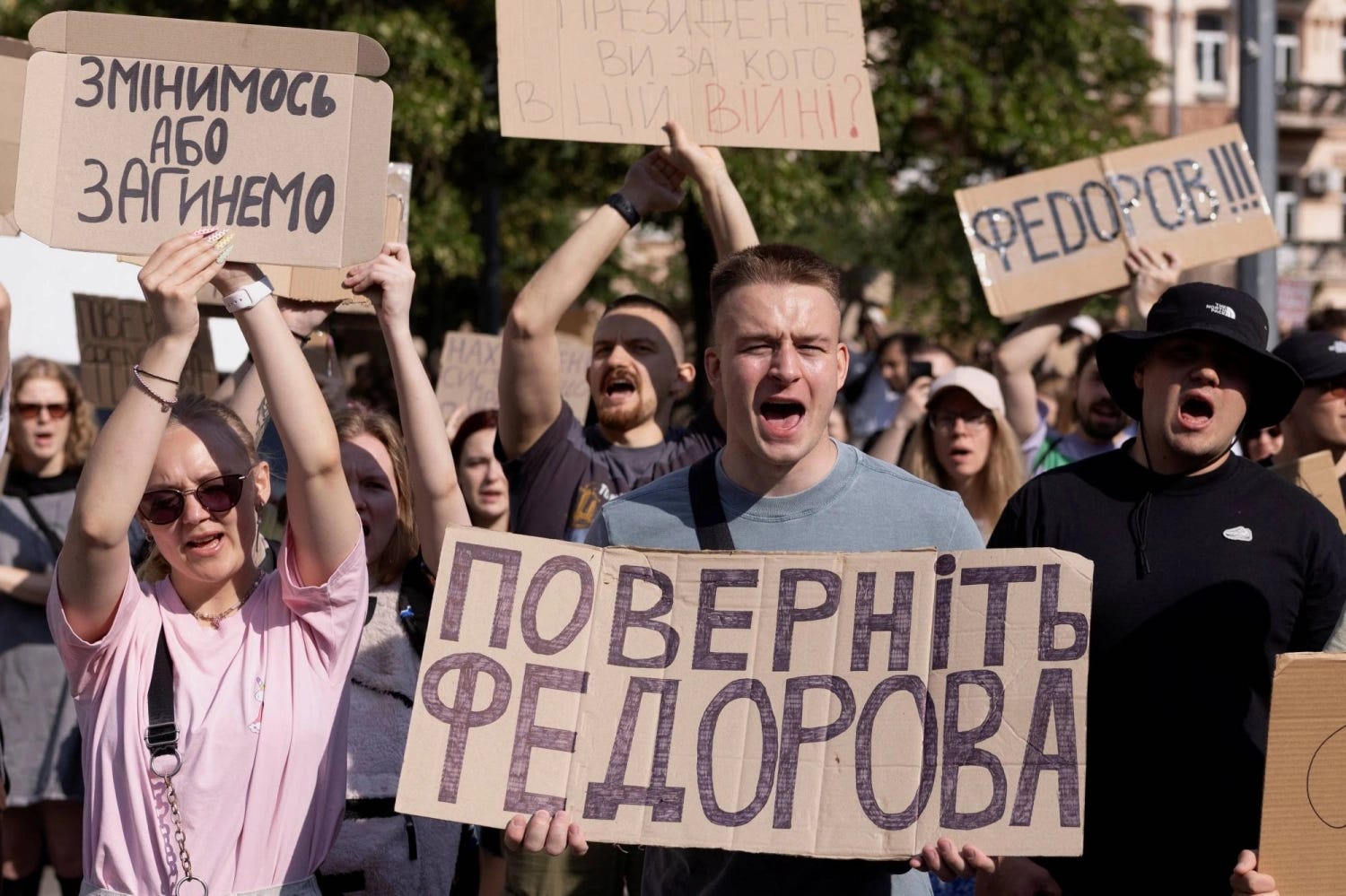
Governments replace cabinet ministers all the time. Even countries at war periodically reshuffle senior officials. Yet mass demonstrations over the dismissal of a defense minister are almost unheard of. That is precisely what unfolded across Ukraine this week as thousands of people gathered in Kyiv, Kharkiv, Lviv, Odesa and other cities to protest President Volodymyr Zelensky’s decision to remove Defense Minister Mykhailo Fedorov. Protesters carried signs reading, “Hands Off Fedorov,” “Why Break What’s Working?” and, perhaps most revealingly, “Fedorov Is Innovation.”
That response should immediately raise a question.
The Motivation to Protest
What would compel people living through an existential war—people who have endured years of missile attacks, blackouts, and unimaginable sacrifice—to conclude that the dismissal of one cabinet minister was important enough to leave their homes and take to the streets?
After spending the day reading not only Western reporting but Ukrainian news coverage and political analysis, I believe the demonstrations are about something much larger than the career of one exceptionally talented government official.
They are about the future direction of the Ukrainian military.
More broadly, they may be about the future of warfare itself. And given the context —a grinding existential war with Russia—they are about the perception that the survival of Ukraine is on the line and Federov is essential to that survival, in the minds of the protesters. They see him as the key to the future of Ukraine and his ouster is a threat to the future.
Rewriting the rules
For more than a century, military power has generally been measured in familiar terms: population, industrial capacity, tanks, aircraft, artillery, and logistics. By nearly every conventional measure, Ukraine entered this war at an enormous disadvantage. Russia possesses a much larger population, a far greater defense industrial base, deeper reserves of military equipment, and substantially greater financial resources.
Yet the war has not unfolded according to those traditional calculations.
Again and again, Ukraine has managed to offset Russia’s numerical advantages through innovation. Long-range drones have struck strategic targets hundreds of miles inside Russia. Cheap autonomous systems have destroyed military equipment worth millions of dollars. Software, artificial intelligence, electronic warfare, decentralized manufacturing, and rapidly evolving battlefield technologies have repeatedly allowed Ukraine to impose costs on an opponent with vastly superior conventional resources.
Whatever the ultimate outcome of the war, Ukraine has already become the world’s most important laboratory for twenty-first century warfare.
Mykhailo Fedorov became one of the principal architects of that transformation.
Who is Fedorov?
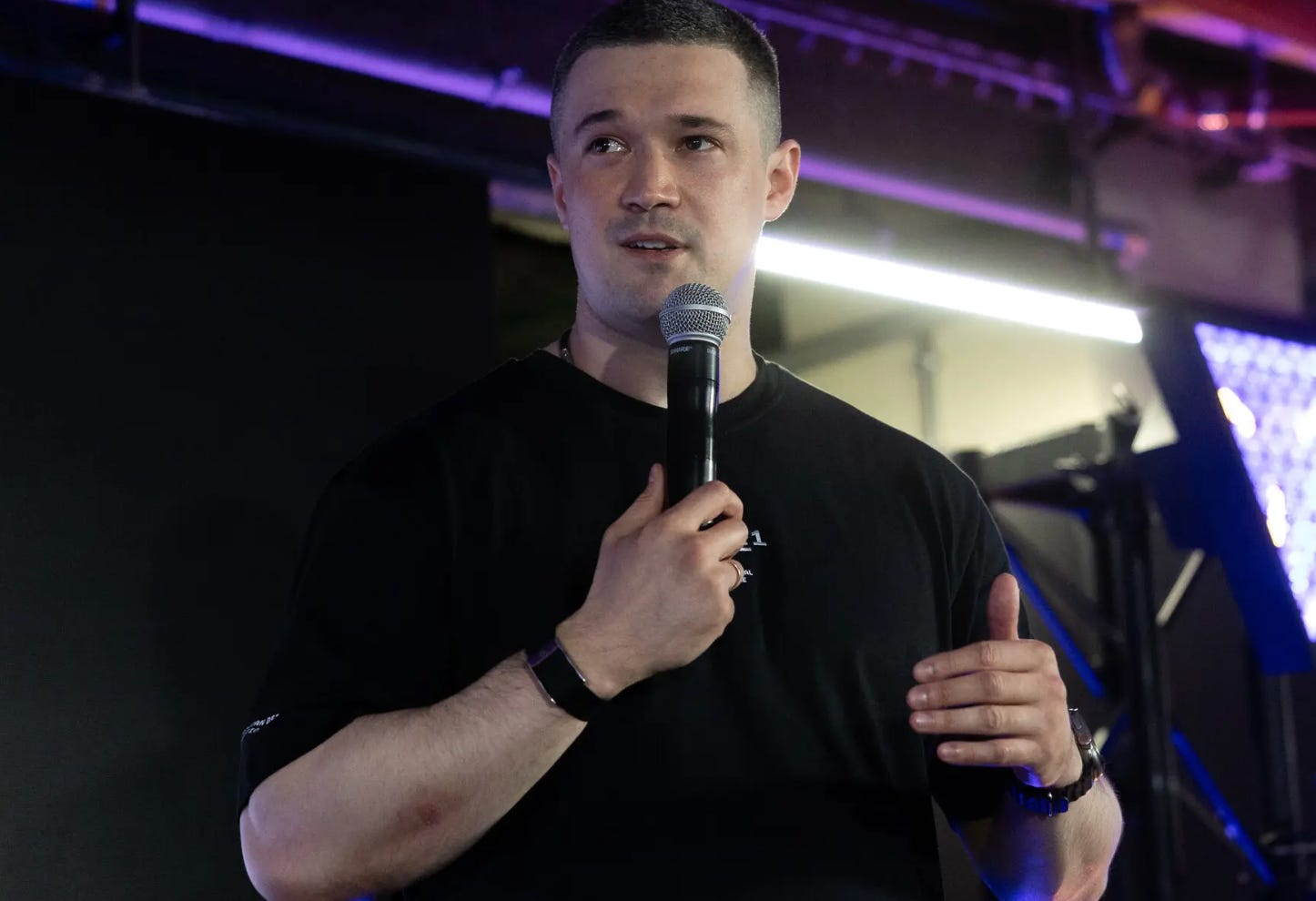
Only thirty-five years old, Fedorov did not emerge from Ukraine’s traditional military establishment. Before becoming Defense Minister, he served as Minister of Digital Transformation, where he helped create Ukraine’s widely admired digital government, including the Diia platform that allowed citizens to access government services through their smartphones. After Russia’s invasion, he played a central role in securing Starlink communications, expanding Ukraine’s drone ecosystem, encouraging partnerships with private technology companies, and accelerating the use of artificial intelligence and other emerging technologies. Earlier this year, Zelensky elevated him to lead the Defense Ministry, where he sought to apply the same philosophy of rapid innovation to the military itself.
His basic premise was difficult to argue with.
Ukraine cannot realistically expect to outproduce Russia in tanks, artillery shells, or manpower.
Its best chance of success is to innovate faster than Russia can adapt.
That strategy appears to have earned Fedorov enormous credibility among younger Ukrainians, military reformers, drone operators, technology entrepreneurs, and many front-line soldiers who increasingly see technological innovation—not industrial production—as Ukraine’s decisive strategic advantage.
This is where the story becomes considerably more complex than much of the initial English-language coverage has suggested.
Ukrainian Sources Say . . .
According to multiple Ukrainian news organizations, including Ukrainska Pravda, RBC-Ukraine, and NV, tensions between Fedorov and Commander-in-Chief Oleksandr Syrskyi had been growing for months. The dispute reportedly extended well beyond personalities. It reflected fundamentally different views about how Ukraine should organize its military, procure equipment, integrate new technologies, and conduct the war itself. Several Ukrainian outlets report that Zelensky privately acknowledged to members of his own parliamentary faction that the conflict between the two men had become irreconcilable.
Fedorov himself has now publicly confirmed that he urged Zelensky to dismiss Syrskyi. He accused the commander of blocking major reform initiatives and argued that Ukraine needed to think “asymmetrically” if it hoped to defeat a much larger adversary. Those are extraordinary statements for a recently dismissed defense minister to make while his country remains at war.
General Syrskyi’s supporters make an equally serious argument. Wars are not won by technology alone. Drones, artificial intelligence, and innovative procurement systems still require disciplined command structures, logistics, operational planning, and unity of command. They argue that military organizations cannot function if every reformer pursues his own vision independently of the chain of command. Every modern military eventually confronts the tension between institutional stability and technological disruption. Ukraine may simply have reached that point sooner than most because the pace of innovation has been so extraordinary.
Entrenched Interests
Several Ukrainian political publications describe the conflict as extending beyond military doctrine into procurement reform and bureaucratic power. They report that Fedorov’s efforts to accelerate procurement, expand private-sector participation, and bypass traditional defense bureaucracies created significant resistance within parts of the military and defense establishment. Those accounts rely heavily on anonymous sources and cannot yet be independently verified. Nevertheless, they appear frequently enough across Ukrainian reporting to suggest that the struggle may have involved much more than a disagreement between one minister and one general.
That possibility helps explain why the public reaction has been so intense.
The protesters were not simply demanding the reinstatement of a popular cabinet official.
They were expressing concern that Ukraine might retreat from the very model of warfare that many believe has allowed it to compete successfully against a much larger military power.
One slogan captured that anxiety better than any political speech could.
“Why break what’s working?”
That is, in many ways, the central question now confronting Ukraine’s leadership.
If the country’s recent successes have indeed been driven by rapid technological innovation, how should that innovation be integrated into a traditional military command structure? How much institutional friction is inevitable when disruptive technologies challenge long-established ways of fighting wars? And how should political leaders balance the need for innovation against the equally essential need for unity of command?
Those are not uniquely Ukrainian questions.
Every major military in the world—including our own—is wrestling with them.
Bottom Line
At this point, there simply is not enough public evidence to say with confidence why President Zelensky ultimately decided that Mykhailo Fedorov had to go. The explanation may lie in an irreparable breakdown between civilian and military leadership. It may reflect broader political calculations within the government. It may involve institutional resistance to reform, concerns over unity of command, or some combination of all of those factors. Responsible analysis requires distinguishing carefully between established facts and informed speculation.
One possibility, however, deserves more attention than it has received.
If Ukrainian reporting is substantially correct, Zelensky may not have been choosing between innovation and the old guard so much as choosing between two risks he considered unacceptable. On one side stood a remarkably successful young reformer who had become the public face of Ukraine’s technological transformation. On the other stood the military leadership and, perhaps, elements of the broader defense establishment that had concluded they could no longer work with him. If that assessment is accurate, Zelensky may have faced a stark choice: retain the architect of Ukraine’s technological revolution and risk a widening fracture inside the institutions responsible for fighting the war, or remove him in order to preserve unity at the top of the defense apparatus.
We simply do not know how much pressure Zelensky was under behind closed doors. We do not know how deep the institutional conflict had become, what ultimatums may have been presented, or what consequences he believed would follow if he refused to act. Those are the questions that historians—and perhaps Ukrainians themselves—will eventually have to answer.
This is a good example of what I’m trying to do here — go deeper and make more sense out of events that are being reported elsewhere, but not deeply analyzed. I wasn’t able to get to the bottom of this yet — but I was able to advance substantially beyond the other western press accounts of this. Thank you for supporting this process, particularly with paid subscriptions.
Sources
https://www.nytimes.com/2026/07/16/world/europe/ukraine-fedorov-protests.html
https://apnews.com/article/88083e4381b1690f5048088d75954d3a
https://www.reuters.com/business/aerospace-defense/who-is-ukraines-mykhailo-fedorov-dismissed-defence-minister-2026-07-16/
https://www.pravda.com.ua/
https://newsukraine.rbc.ua/
https://english.nv.ua/
https://kyivindependent.com/
Really helpful - and I hadn't heard/seen this elsewhere. I look forward to your ongoing discoveries on this. There are many parallels with the disruptions our government has been undergoing the past nearly 20 months... when I pause and ask the key question... 'so how is that going' ... well... 'nuff said or I'll be writing all day...
Thanks again, Michael for bringing this to the table!
The young man in the middle of the photo is holding a clearly lettered cardboard sign that says: ПОВЕРНіТЬ ФЕДОРОВА. Translation: Return (bring back) Fedorov.