

Something unusual happened in Moscow on Tuesday.
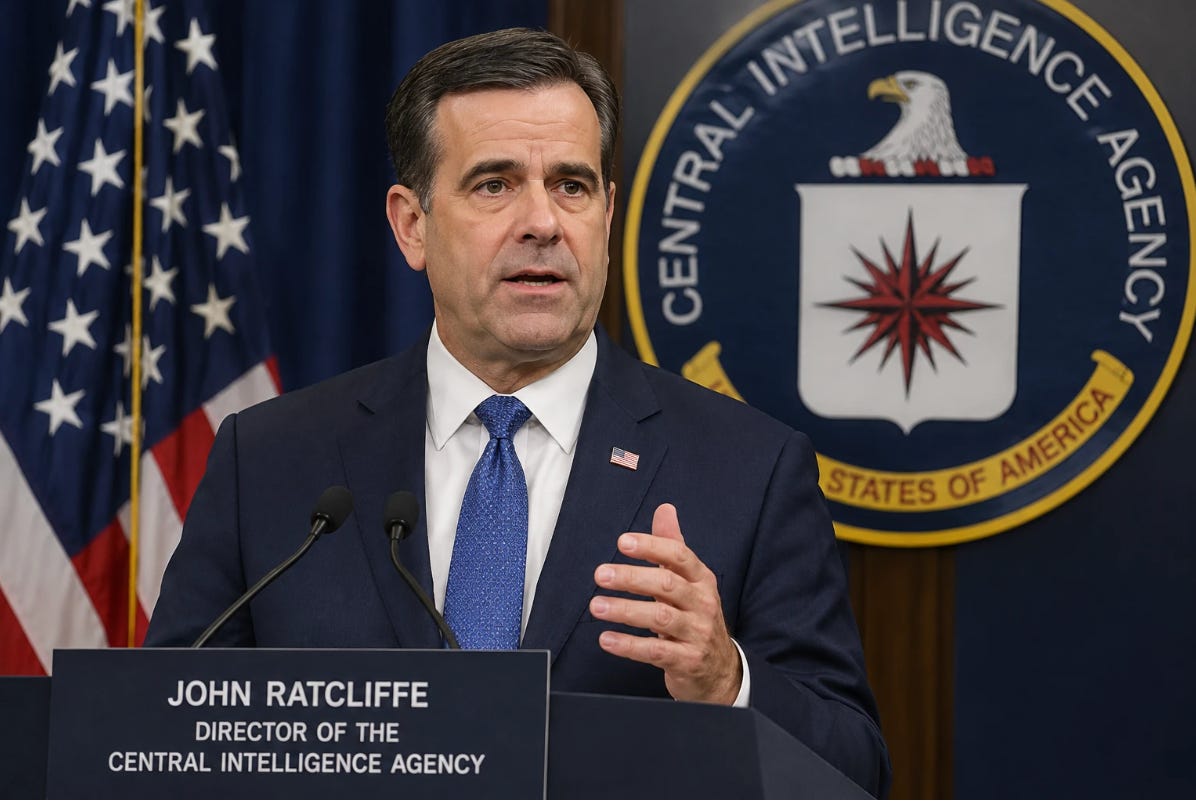
CIA Director John Ratcliffe flew into the Russian capital aboard a U.S. military aircraft, remained on the ground for roughly eight hours, met with senior Russian intelligence officials, and then flew out again. The trip had not been announced, the White House has offered no substantive explanation for it, and the CIA isn’t talking.
The Kremlin has now confirmed that Ratcliffe met with his Russian intelligence counterparts, although apparently not with Vladimir Putin himself. But there is one additional detail worth noting: according to Kremlin spokesman Dmitry Peskov, Putin was promptly briefed on the results of the discussions.
Meanwhile, before Ratcliffe arrived, the United States took the extraordinary precaution of informing Ukraine that a senior American delegation would be in Moscow and asking Kyiv to suspend strikes on Moscow and St. Petersburg until the Americans were safely out.
So what’s up with this?
In the absence of an official explanation, there is a natural temptation to fill the vacuum with speculation, and some of that is already getting pretty wild. I don’t think we need to do that. There are enough indicators in plain sight to narrow the possibilities considerably, while still acknowledging that we don’t know the answer.
Start With the Messenger
The first question I would ask is not what crisis was occurring Tuesday. It is why Donald Trump chose John Ratcliffe to handle it.
If Trump wanted to conduct another round of negotiations over Ukraine, he has Steve Witkoff and other political emissaries who have been doing precisely that. If this were ordinary diplomacy, there is a secretary of state and an American diplomatic establishment. Instead, Trump sent the director of the Central Intelligence Agency to meet privately with Russia’s intelligence leadership.
That tells us something about the nature of the conversation, even if it doesn’t tell us what was said.
Intelligence chiefs maintain channels with adversaries precisely because there are certain conversations governments do not want to conduct publicly—or sometimes even through conventional diplomatic channels. A CIA director can sit across from his Russian counterpart and say, in essence, we know what you’re doing. He can explain enough of what the United States knows to establish that a warning is real without publicly exposing the intelligence behind it. He can communicate consequences, and he can listen to the response.
There is an obvious precedent. In November 2021, President Biden sent CIA Director William Burns to Moscow after U.S. intelligence detected Russia’s preparations for what would become the invasion of Ukraine. Burns carried a warning about what Washington knew and what the consequences would be if Putin proceeded.
Ratcliffe’s trip does not necessarily mean something equally dramatic is happening now. But the precedent is difficult to ignore.
The NATO Possibility
There is a significant piece of reporting pointing in this direction. CBS News reports that recent U.S. intelligence assessments indicate Putin’s risk calculus may be changing—that he may be increasingly willing to authorize provocative actions against NATO countries, including hybrid and deniable operations intended to test both the alliance and the Trump administration.
Readers may remember that we examined exactly this problem nine days ago — see Russia’s Hybrid War Against NATO Escalates.
Russia has been conducting what NATO itself describes as a hybrid campaign against Western countries: sabotage, cyberattacks, infrastructure disruption, assassination plots, incendiary attacks and the recruitment of proxies to conduct operations while preserving Moscow’s plausible deniability. The objective is not necessarily to start a conventional war with NATO. It is to weaken and intimidate NATO while operating just below the threshold that would provoke one.
The concern now appears to be that Putin may be becoming more willing to approach—or perhaps cross—that threshold.
Former Deputy Director of National Intelligence Beth Sanner has offered one plausible interpretation of Ratcliffe’s mission: Washington may have discovered something Russia was considering and sent Ratcliffe to make clear that the United States knew about it and wanted Moscow to stop.
There is a great deal about that explanation that makes sense. But there is one part that doesn’t quite resonate with me, and it isn’t the intelligence. It’s Trump.
Donald Trump has spent years criticizing NATO allies, questioning America’s obligations to them, demanding greater European defense spending and generally displaying far less attachment to the Atlantic alliance than virtually any modern American president. That certainly doesn’t mean he would sit back and allow Russia to attack a NATO member, but it makes me somewhat skeptical that a dramatic reaffirmation of America’s commitment to NATO, standing alone, would have prompted this particular mission.
If NATO was the reason Ratcliffe went to Moscow, I suspect Trump’s message would have sounded more like this:
We know what you’re doing. You’re getting dangerously close to triggering something that will force me into a confrontation with you. Neither of us want that. Stop.
That would require no sudden conversion to Atlanticism. Trump doesn’t have to love NATO to understand that a Russian operation that kills Americans, produces a serious Article 5 crisis, or otherwise forces the United States into a confrontation with Russia becomes his problem.
And that interpretation actually fits Russia’s hybrid strategy rather well. The danger isn’t necessarily that Putin has decided to invade Poland. It may be that American intelligence believes Moscow is becoming increasingly reckless about activities deliberately designed to remain below the threshold of war—and Washington fears Putin may miscalculate where that threshold actually lies.
That is certainly serious enough to justify sending the CIA director.
But there is another possibility that, to me, fits Trump even better.
What If This Was About Iran?
Look at what else was happening when Ratcliffe boarded that airplane.
Iran is now arguably Trump’s most urgent foreign-policy problem, and the United States has just dramatically escalated its economic campaign against Tehran. On Monday—one day before Ratcliffe arrived in Moscow—the Treasury Department announced a sweeping new sanctions and diplomatic campaign intended to intensify economic pressure on Iran.
Russia is potentially a major obstacle to that strategy.
Moscow is Tehran’s most important great-power partner. The Washington Post reports that Russia has provided Iran with targeting intelligence concerning the location of U.S. military assets in the region. Russia can provide military assistance and intelligence, help Tehran circumvent economic isolation, and give Iran diplomatic and strategic breathing room precisely when Trump is trying to deny it those things.
Now go back to the question we started with: why Ratcliffe?
Suppose the American message wasn’t primarily about sanctions or diplomacy. Suppose Washington has intelligence showing precisely what assistance Russia is giving Iran, what information is being passed, and how that assistance is affecting American forces or Trump’s campaign against Tehran.
In that circumstance, sending the CIA director makes considerable sense. Ratcliffe could tell his Russian counterparts what Washington knows, make clear that Russian assistance is becoming unacceptable, and establish consequences if it continues—all without revealing publicly how the United States knows it.
Unlike defending Lithuania or Poland out of devotion to NATO, Iran is also a problem Trump urgently needs to solve. For that reason, I put Iran fairly high on my list of possible explanations for the trip.
Or Perhaps We’re Asking the Wrong Question
There is another possibility that strikes me as increasingly plausible: perhaps Ratcliffe didn’t fly to Moscow to discuss one thing.
Consider the potential agenda sitting in front of him. American intelligence believes Russia may be becoming more aggressive in its hybrid operations against NATO countries. Russia is assisting Iran at precisely the moment Trump is dramatically escalating pressure on Tehran. Meanwhile, negotiations over Ukraine remain stalled, Russia and Ukraine continue exchanging long-range strikes, and Washington needs to understand what Putin intends to do next.
Those issues aren’t necessarily separate compartments. They are pieces of the same U.S.-Russia relationship.
Viewed that way, Ratcliffe may have carried something more complicated than a warning. He may have carried the outlines of a transaction.
Russia wants things from Trump: sanctions relief, improved relations with Washington, movement toward an acceptable settlement in Ukraine, and recognition of Russia’s status as a great power. Trump wants things from Putin as well. He wants Russia not to undermine his campaign against Iran, not to create a NATO crisis that forces the United States into a confrontation, and presumably to give Washington something it can work with in Ukraine.
That begins to sound considerably more like Donald Trump.
It also helps explain why the conversation might occur through intelligence channels rather than conventional diplomacy. Ratcliffe may have been carrying a message that combined intelligence warnings with a much broader proposition about the future U.S.-Russia relationship.
That is speculation, and I want to label it clearly as such. But in trying to understand an opaque event like this, one useful question is not simply what was happening in the world that might justify a CIA director’s trip? It is what combination of problems would be important enough to Donald Trump personally that he would send his CIA director to Putin’s intelligence chiefs?
When I look at it that way, Iran moves upward; NATO moves somewhat downward but remains very much alive; and the possibility that Ratcliffe discussed Iran, NATO and Ukraine as parts of a larger package begins to look more plausible than any single explanation standing alone.
What About the “Doomsday Planes”?
There is one other piece of this story getting considerable attention online. Within hours of Ratcliffe’s departure from Moscow, civilian flight trackers reportedly showed several Navy E-6B Mercury aircraft airborne over the United States.
These aircraft are part of America’s nuclear command-and-control system. They maintain communications with U.S. strategic nuclear forces, including ballistic-missile submarines, and inevitably acquire the ominous nickname “doomsday planes” whenever they appear in a news story.
The timing has produced predictable speculation that Ratcliffe rushed to Moscow to warn Putin about something involving nuclear weapons and that America subsequently put its nuclear command aircraft into the air.
There is presently no evidence establishing that connection.
E-6Bs fly regularly. Their entire purpose is to maintain a survivable nuclear command-and-control capability, and multiple aircraft being airborne does not by itself mean the United States has gone onto some extraordinary nuclear alert. So far, I have seen no convincing evidence of the other strategic-force movements I would expect to accompany a significant change in America’s nuclear posture.
For now, I regard the airplanes as an interesting contemporaneous data point, not an intelligence indicator upon which I would build an assessment. If additional evidence emerges, we can revisit it.
Something Happened. We Just Don’t Know What. Yet.
We know the trip happened. We know that it was highly unusual. And we can identify likely topics that would justify such a move. But that’s about as far as facts and analysis can take us this morning.
The CIA director secretly flew to Moscow after the United States took the extraordinary precaution of asking Ukraine to suspend attacks on Russia’s two largest cities while he was there. He spent roughly eight hours on the ground and met with Russia’s intelligence leadership. Ratcliffe apparently did not meet Putin himself, but according to the Kremlin, Putin was promptly briefed on the discussions afterward. Neither Washington nor Moscow has offered a meaningful account of what was said.
My own weighting at this point puts Iran somewhat higher than most of the public discussion does, with the NATO/hybrid-warfare intelligence as a very serious second possibility. Ukraine almost certainly entered the conversation as well, and I would not be surprised if the eventual answer turns out to involve all three.
What we are left with is this: something was sufficiently sensitive, sufficiently important—or sufficiently urgent—that Donald Trump decided the appropriate person to deliver the message was the director of the Central Intelligence Agency.
That is the intelligence indicator I would pay the most attention to. Not the airplanes or the rumors, but the choice of messenger.
MS Comment: This is one of those where I wish I could be more certain but if we’re doing serious analysis — then I’ve gone about as far as I can at this time in trying to figure this one out. Let me know your thoughts in the comments. I suspect that in the coming days this will become more clear.
Audio Listeners can stop here.
Sources
https://www.cbsnews.com/news/cia-director-john-ratcliffe-russia-secret-trip/
https://www.reuters.com/world/kremlin-says-us-spy-chief-held-talks-with-russian-counterparts-during-moscow-2026-08-26/
https://www.reuters.com/world/us-spy-chief-visits-russia-meetings-media-reports-2026-08-25/
https://www.washingtonpost.com/national-security/2026/08/25/cia-director-moscow-rare-unannounced-trip/
https://www.wsj.com/world/cia-director-john-ratcliffe-makes-surprise-trip-to-moscow-c1c68fa6
https://apnews.com/article/4efffcaac5ef6736e2b10cef73054e48
https://abcnews.com/International/ukrainian-drone-attacks-moscow-resume-hours-after-ratcliffe/story?id=135962437
https://www.navair.navy.mil/product/E-6B-Mercury
https://www.nato.int/en/what-we-do/deterrence-and-defence/countering-hybrid-threats
https://www.nato.int/en/about-us/official-texts-and-resources/official-texts/2024/05/02/statement-by-the-north-atlantic-council-on-recent-russian-hybrid-activities
What about the mid-term elections? Trump needs Russian support again. And Ratcliffe is more of a political operator than a CIA operative.
Trump was recruited, and given code name Krasnov in 1989 when he married the daughter of a Czech KGB operative. Apparently his intelligence hires were vetted as being Moscow symps.
The big draw of the Christian right towards Moscow is that they are anti DEI, orthodox Christians
The Russian orthodox church is an adjunct of the KGB, err FSB, the Priests were KGB agents and upchanneled confessions to KGB dossiers.
Russia is a theocratic oligarchy.