
Trump's NYT Interview Transcript Reveals His Belief in a Post-Constraint Presidency (and a lot more)
Across 23,000 words, the interview sketches a presidency defined not by what is illegal, but by what can be done before anyone can stop it.

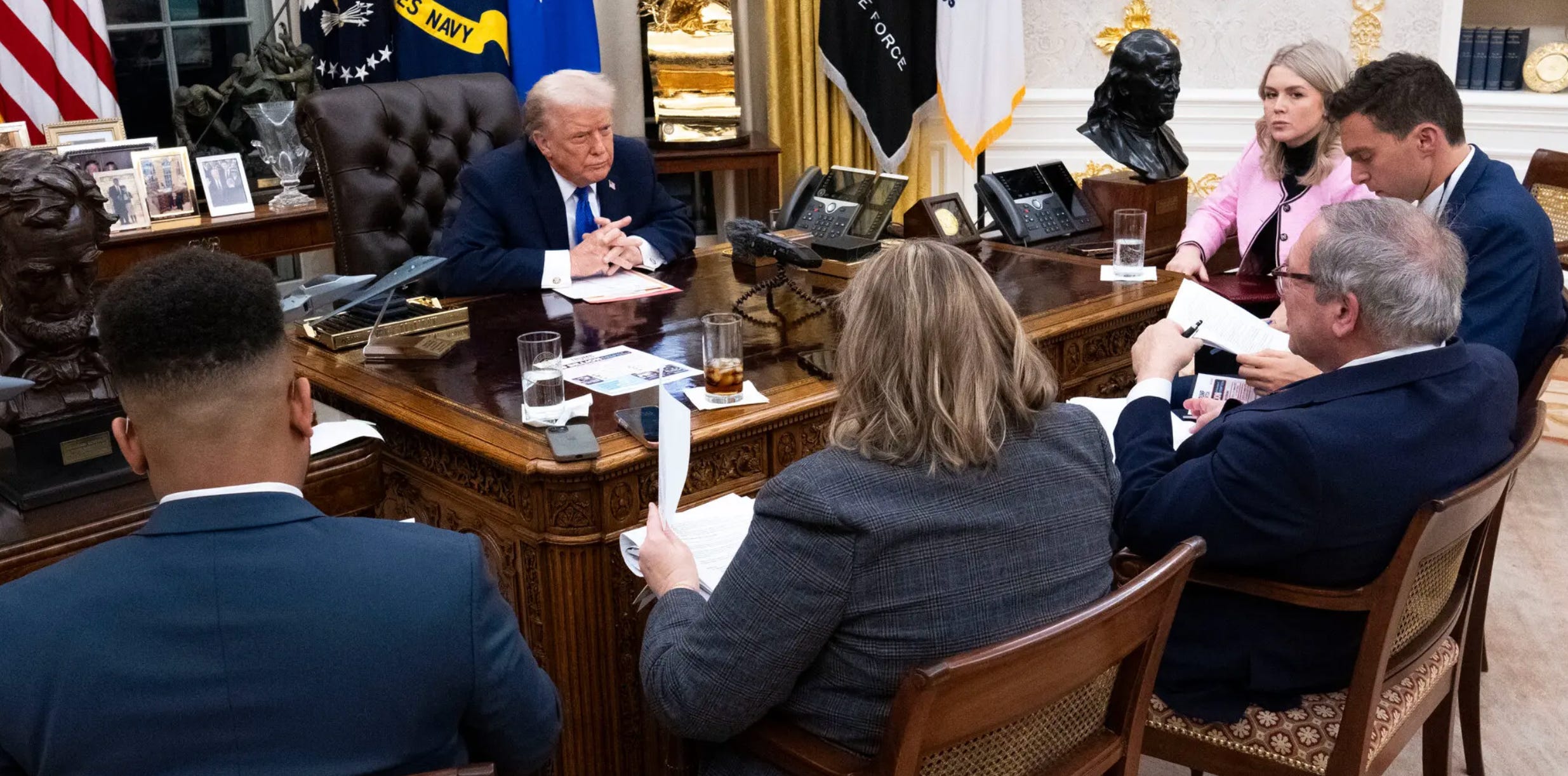
Earlier today, The New York Times quietly published the full transcript of its two-hour interview with Donald Trump — more than 23,000 words, released all at once. Prior to the publication of the transcript, all we had to go on were the snippets released previously—mostly his comments on not feeling constrained by international law.
Now we have the whole transcript (gift link here.)
We are used to getting Trump in small bites — this is different. Read in full, it is not merely a collection of provocative answers or headline-ready quotes. It is something rarer and more revealing: a sustained exposition of how Trump now understands presidential power — after his first term, after the indictments, after the court battles, and after years of institutional resistance. I know there is a tendency to dismiss Trump as not capable of coherent thought, not capable of an organized world view, not capable of strategic thinking. And indeed, this interview does not reveal him to have unexpected intellectual weight — but it does reveal him. It does reveal how he thinks. For me, it was meaningful. I gained insight.
So what I am going to attempt to do here is not just harvest quotes and roll my eyes at them. Rather, I’m going to try to harvest some insights that I believe are revealed.
One thing that belongs here, up front, is this: across 23,000 words, the interview sketches a presidency defined not by what is illegal, but by what can be done before anyone can stop it. This manifests is many different ways, across many different topics. Trump doesn’t argue that laws don’t exist, or that courts have no role, or that institutions are meaningless. But he arguesa — implicitly but consistently — that those constraints come into play after action, not before it. They are risks to be managed, delays to be absorbed, or obstacles to be overwhelmed by speed, momentum, and irreversibility.
This is a post-constraint presidency. Not lawless in the cartoon sense, but post-constraint in a more precise way: a presidency in which traditional checks still exist on paper, yet no longer function as true decision-point limits. Action comes first. Accountability, if it arrives at all, comes later — often too late to reverse what has already been done.
Read with this lens, the interview stops looking like a grab bag of controversial statements and starts to read like a user’s manual. Patterns repeat. Justifications recur. Assumptions about power, loyalty, speed, and resistance appear again and again across topics that otherwise seem unrelated. And just as important as what Trump says is what he never offers: any clear limiting principle outside his own judgment.
Once you read the transcript this way, the most revealing parts are no longer the loudest lines — but the quiet consistencies beneath them.
I. Constraint, Displaced in Time
One of the most consistent — and revealing — patterns in the interview is how Trump talks about limits: legal, institutional, political. They are rarely treated as barriers to action. Instead, they appear as considerations that arise after action has already been taken.
When asked whether certain actions would be lawful or constitutional, Trump repeatedly declines to engage the question at the point it is posed. “You’ll see,” he says at several moments in the interview, or offers some variant of “we’ll see what happens.” The emphasis is not on authorization, but on outcome. The act precedes the judgment.
Pressed on whether courts might block or reverse his actions, Trump’s responses are tellingly casual. Lawsuits and judicial review are framed as delays rather than restraints. At one point, he waves off the prospect of legal challenge altogether, suggesting that by the time courts act, “it’s already done.” Elsewhere, he describes judges as something you “deal with later,” not something that determines whether an action should proceed in the first place.
The same temporal inversion appears in his discussion of public backlash. Trump repeatedly minimizes criticism as fleeting and elite-driven. “People wanted this,” he insists, even when institutions object. Outrage, in his telling, “dies down,” while results endure. Opposition is not treated as a signal to reconsider, but as confirmation that decisive action was overdue.
Throughout the transcript, Trump returns to the idea that decisiveness itself confers legitimacy. He praises acting “fast,” complains about “people slowing things down,” and contrasts his approach with leaders who, in his words, “wait too long” or “get tied up.” Speed is not merely tactical. It is moral. To move quickly is to be effective; to hesitate is to fail.
What is striking is not that Trump dismisses law or institutions outright — he rarely does that explicitly — but that he consistently relocates them downstream. Courts still rule. Laws still exist. Critics still protest. But none of these function as true decision-point constraints. They are risks to be managed, delays to be outrun, or noise to be ignored once action has been taken.
This is the operational core of the post-constraint presidency. Constraint has not vanished; it has been displaced in time. Action comes first. Accountability, if it arrives at all, comes later — when facts are already on the ground and reversal is far harder than initiation.
Once this pattern becomes visible, it appears again and again across the interview, regardless of topic. And it raises a deeper question that the transcript never answers directly: if law, courts, and backlash no longer operate as brakes at the moment of decision, what does?
II. Speed as a Governing Virtue
If constraint is displaced in Trump’s account of presidential power, speed is what replaces it.
Throughout the interview, Trump repeatedly returns to the idea that acting quickly is not merely advantageous, but decisive — morally, politically, and institutionally. Delay is framed as weakness. Process is treated as evasion. Hesitation, in his telling, is how problems metastasize.
Asked why previous efforts failed — whether in policy, enforcement, or diplomacy — Trump’s answer is rarely that the goal was wrong. It is that action was too slow. Others “waited,” “got bogged down,” or “let it drag on.” He contrasts this with his preferred approach: move immediately, establish facts on the ground, and force the system to respond to a new reality.
At several points, Trump emphasizes that once something is done, opposition changes character. Lawsuits follow rather than precede action. Negotiations begin from a position of altered facts. Critics adjust to what already exists. As he puts it in one exchange, once you act, “they have no choice but to deal with it.”
This logic appears across domains that are otherwise unrelated. Whether discussing domestic policy, institutional reform, or international disputes, Trump treats speed as a form of power in itself. Acting quickly creates irreversibility. It compresses the window in which courts can intervene, bureaucracies can resist, or public opinion can harden against the move.
Importantly, speed is not described as reckless. Trump consistently frames it as common sense. Those who insist on process are portrayed as hiding behind procedure or afraid of responsibility. “You can’t wait,” he says in various forms. Waiting is how things “get worse.”
In this framework, legality becomes something tested after the fact. If courts later weigh in, that is part of the landscape — but not something that should prevent action at the outset. The same is true of political backlash. By the time resistance organizes, the decision has already reshaped the terrain.
This is why so many of Trump’s answers pivot away from permission and toward execution. The underlying assumption is that momentum itself confers legitimacy. Once something exists, undoing it is harder than living with it. Speed does not just overcome resistance; it transforms resistance into accommodation.
Taken together, these passages reveal something more than impatience or bravado. They reveal a governing philosophy in which speed substitutes for restraint. Where law once slowed action, velocity now overwhelms it. Where deliberation once filtered decisions, momentum now settles them.
This is not accidental. It is the functional engine of the post-constraint presidency — the means by which power outruns its own limits.
III. Institutions Have No Inherent Legitimacy
A striking feature of the interview is that Trump rarely treats institutions as possessing legitimacy in their own right. Courts, federal agencies, prosecutors, and even the press are not described as independent authorities whose role is to constrain executive power. Instead, their legitimacy is presented as contingent — something they earn, or forfeit, based on behavior.
The governing principle is simple and consistent: institutions are legitimate when they comply, and suspect when they resist.
Throughout the transcript, Trump praises institutions and officials who “did their job” or “got it done.” But “doing the job” is not defined in institutional terms — fidelity to law, independence, or procedure. It is defined operationally: whether the institution advanced his objectives or slowed them down. Alignment is treated as competence. Resistance is treated as failure.
This logic appears most clearly in Trump’s discussion of the Justice Department and the courts. Rather than acknowledging independence as a constitutional safeguard, he repeatedly questions why these institutions should operate beyond presidential direction at all. Judges and prosecutors are not described as neutral arbiters standing outside politics, but as political actors themselves — participants who chose sides. Once that assumption is made, pressure on them no longer appears improper. It appears corrective.
The same reasoning extends to federal agencies more broadly. Bureaucracy is framed not as expertise or continuity, but as inertia. Agencies are valuable when they move quickly and execute priorities. When they hesitate, question, or resist, that behavior is cast as obstruction — even sabotage. Institutional independence, in this telling, is not a virtue. It is evidence of disloyalty or bad faith.
The press occupies a similar position in Trump’s account. Media organizations are not described as watchdogs or critics operating outside the political system. They are treated as actors within it — entities that “did things,” took sides, and therefore forfeited any claim to special protection. Once journalism is reframed as political participation, retaliation no longer looks like repression. It looks like accountability.
What unites all of this is the rejection of inherent institutional legitimacy. Institutions do not constrain power because of who they are or what role they serve. They matter only insofar as they support execution. Their authority flows upward from alignment, not downward from law or tradition.
In this framework, independence is not a safeguard. It is a challenge. And challenges, as Trump makes clear throughout the interview, are not to be deferred to — they are to be overcome.
IV. Loyalty Over Independence
Once institutions lose inherent legitimacy, independence itself becomes suspect. What replaces it, in Trump’s account, is loyalty — not always named explicitly, but consistently rewarded and expected. (Comment: This is not exactly “news” — but he conveyed it in enough different ways to cause it to make the list here, not as something we didn’t know, but as something he articulated thoroughly.)
Throughout the interview, Trump repeatedly divides officials into two categories: those who “did what they were supposed to do” and those who did not. The distinction is not about competence in a professional sense. It is about alignment. Officials are praised not for independent judgment or adherence to institutional norms, but for cooperation, responsiveness, and willingness to execute without resistance.
Those who resist are not described as conscientious or principled. They are framed as obstacles. They “got in the way.” They “slowed things down.” They “thought they knew better.” Independence, in this telling, is recast as ego, sabotage, or political hostility. The idea that an official might have a duty not to comply rarely appears as a legitimate possibility.
This framing extends upward as well as downward. Trump consistently treats loyalty as a marker of trustworthiness and resistance as evidence of bad faith. Officials who question decisions are assumed to have ulterior motives. Those who comply are assumed to be acting in the country’s interest. The possibility that loyalty and legality might diverge is never meaningfully engaged.
What makes this especially consequential is that Trump does not describe loyalty as personal fealty in crude terms. He frames it as common sense. People who work for the president, in his view, should want to carry out the president’s agenda. Those who hesitate or object are portrayed as violating that basic expectation.
This logic quietly inverts the traditional role of independent officials. In a constraint-based system, independence exists precisely to introduce friction — to slow action, to ask whether something should be done, not just whether it can be done. In Trump’s post-constraint framework, that friction is treated as failure. The official who pauses is less valuable than the official who acts.
The result is a governing environment in which loyalty substitutes for institutional restraint. Rather than being constrained by independent actors, power is filtered through trusted ones. Rather than being checked by internal resistance, it is streamlined through compliance.
Once that shift occurs, many other features of the interview fall into place. The impatience with courts. The disdain for process. The emphasis on speed. The confidence that resistance will collapse. All of it depends on a simple premise: the people in key positions will either align, or be replaced.
That premise is never stated outright. It doesn’t need to be. Across the transcript, it is treated as self-evident.
V. Crisis =Justification, Not Risk
Running beneath the entire interview is a steady, unrelenting sense of crisis. The country is described as being in decline, under threat, surrounded by failure, and damaged by hesitation. What is striking is not that Trump invokes danger — presidents often do — but how he uses it.
Crisis, in this telling, is not a condition that demands caution. It is a condition that discredits restraint.
Again and again, Trump frames the present moment as exceptional. Ordinary rules, ordinary timelines, and ordinary limits are portrayed as inadequate to the scale of the problem. “This isn’t a normal situation,” he suggests in various forms. And once the situation is defined as extraordinary, the mechanisms designed for ordinary times are quietly set aside.
In this framework, risk is not something to be managed through deliberation or institutional process. It is something created by delay itself. Waiting becomes dangerous. Hesitation allows threats to grow. Process is recast as indulgence — something appropriate for calmer periods, not moments of urgency.
This inversion does crucial work. If crisis is permanent rather than temporary, then emergency logic becomes the default. Exceptional authority no longer needs special justification. It becomes the baseline response to a world that is always on the brink.
Importantly, Trump does not describe this crisis as time-bound. There is no clear endpoint at which normal constraints would reassert themselves. The threats he describes — cultural, political, economic, institutional — are open-ended. They do not resolve. They persist.
That persistence matters. A temporary emergency might justify temporary departures from normal process. A permanent emergency justifies permanent expansion of power.
Within this logic, opposition itself becomes evidence of the crisis. Resistance is not a sign that limits are working; it is proof that the system is broken and must be overridden. Institutions that slow action are not safeguarding democracy. They are endangering it by refusing to recognize the urgency of the moment.
This is why so many of Trump’s answers slide easily from diagnosis to execution. Once crisis is assumed, restraint looks irresponsible. Speed looks prudent. Loyalty looks necessary. And power that would otherwise appear excessive begins to look merely proportional.
Crisis, in other words, is not a warning sign in Trump’s account. It is the moral permission structure for everything else the interview advances.
VI. The Missing Limiting Principle
For all its length and detail, the most consequential feature of the interview may be what it never supplies: a limiting principle.
Across 23,000 words, Trump discusses law, courts, institutions, opposition, and backlash. But nowhere does he clearly articulate a line he would not cross, a condition under which he would refrain from acting, or an authority he would accept as final at the moment of decision. Constraint appears only after the fact — as litigation, criticism, or delay — never as a reason to stop.
This absence is striking precisely because Trump is otherwise explicit about so much. He is clear about the value of speed. Clear about the role of loyalty. Clear about his impatience with institutions that resist. Clear about his belief that decisive action reshapes reality. What he does not describe is any external brake on that action beyond his own judgment.
When pressed on legality, he defers to outcome. When asked about courts, he speaks of delay. When confronted with backlash, he predicts collapse. The system is always something to be navigated, managed, or outpaced — never something that determines whether action should proceed.
In a constraint-based presidency, limiting principles are not personal. They are structural. They exist outside the individual, and they bind regardless of intention. In the vision that emerges from this interview, those principles have been internalized — relocated from institutions to instinct.
What restrains such a presidency, then, is not law, or courts, or norms, or opposition. It is confidence in the decision-maker’s judgment, and faith that outcomes will justify methods.
That may be enough for some readers. But it is a fundamentally different conception of executive power than the one the American system was designed to sustain.
The significance of this interview is not that Trump says something shocking. It is that, taken as a whole, he offers a coherent account of presidential power without external constraint — and does so calmly, consistently, and without apology.
This is not a preview of what he might do. It is an explanation of how he believes power now works.
And that is why the full transcript matters.
What This Means to Me
I’ve spent my adult life trying to understand people. In the CIA, that wasn’t an abstraction — it was the work. You tried to understand people you might recruit, or handle, or resist; volatile leaders in volatile countries; individuals whose decisions could move events in ways that weren’t obvious on the surface. In that sense, sitting with this transcript — all 23,000 words of it — felt familiar. America today feels volatile. Its leadership questions are no longer theoretical. And understanding how a president actually sees power matters.
I’m aware that some readers will be impatient with an attempt like this — with trying to extract coherence, structure, or meaning from a long, meandering interview rather than reacting to its most provocative lines. I get that. This kind of close reading isn’t for everyone, and I can’t promise that insights gained this way will always lead somewhere immediately useful. But I do think there’s value in the exercise itself. Immersing myself in the transcript, reading it whole, and looking for patterns rather than moments, gave me a clearer sense of how Trump understands the presidency, how he sees institutions, how he processes resistance, and how he is likely to react when challenged.
For me, that made the time well spent. I can’t guarantee it will feel that way to every reader. But I do feel — after reading every word and trying to make sense of it as a unified object — that my understanding of the world according to Trump moved up a notch or two. And when power is exercised the way this interview suggests it may be, understanding the worldview behind it is not a luxury. It’s a form of preparedness.
If you value this kind of work — reading past the headlines, slowing things down when everyone else is speeding up, and trying to understand how power actually operates rather than how it’s marketed — I hope you’ll consider becoming a paid subscriber. This newsletter exists because a small group of readers believe that taking the time to look closely still matters. I’m grateful to those of you who make that possible, and I’m glad to have you along for the work.
Michael, in your close reading of this transcript, you've accurately articulated the patterns of Trump's mind...the deep-seated, unconscious beliefs that organize all his thoughts, feelings, and behaviors. I'm psychoanalytically trained in infant and early child development. Knowing something of the emotional deprivation Donald experienced in his first two years of life, and the emotional abuse from that time forward, no child could have developed a good feeling about his intrinsic self in a family with such an emotionally absent mother and verbally abusive father.
The patterns you describe map onto a deprived infant's experience of himself and the world. He's the center of the world; mother SHOULD orbit around him. To an infant, as to Trump, that's just logical. (Every infant needs a caregiver whose primary preoccupation is with that helpless baby.) Babies need others to FUNCTION for them. Other people only matter to an infant when they can serve that baby's needs. Otherwise, they are irrelevant, or even harmful, from the baby's point of view. To Trump, other people, institutions, etc. are only relevant in so far as they serve HIS purposes. If they comply with his demands they are "good,' if they don't, they are "bad" or even mortal enemies out to destroy him. Just like a chronically neglected baby, he can become enraged easily and can't tolerate not being the supreme center of attention.
When Trump talks about "the country," he means himself. HE feels threatened, not the country. HE feels damaged, not the country. Every other country is short-changing the U.S., meaning HE'S been short-changed by a bad mommy and dad. They owe the U.S. big time, means that HE feels entitled to something he never got. In his mind, his needs are the ONLY things that matter, and those who don't see it that way have no place in his mind and may not even deserve to exist. He once told Bob Woodward, as if telling him a secret, that "Everything is Mine."
It may be really hard to believe that an adult man could be functioning at the developmental level of an infant/toddler. But profoundly neglected children can turn out that way. If you look at the world Trump creates around him, you'll see Trump at the center doing very little except enriching himself, denigrating others, and giving orders. They have to psychologically and literally function for him, the way a baby needs others to do. They are the target of his intense wrath, his narcissistic rage, when they display ANY autonomy or differ with him in any way. If they do, as Mike Pence did, then "maybe [Pence] deserved to be hung."
The reason millions of us keep trying to understand the latest thing he's done or said, is because we don't understand the deep-seated core of his lived experience. His development became arrested at the earliest stage. Freud said that "we don't understand other people ("hysterics") because we don't have their memories."
The struggle most of us have is that Trump's mind is so different from anything we've ever experienced in an adult man. We've never seen a man with absolutely NO CONSCIENCE, no moral compass beyond what's good for him. If it aggrandizes him then it's good, and everyone else ought to see it that way too. He's DANGEROUS precisely for this reason, and he doesn't mind ignoring the pesky laws and courts that would restrain him, just as he ignored his parents who weren't worthy of his respect. As he did as a child, he just regroups and makes an end-run around them. It might even enhance his sense of self to see others frustrated when they can't contain him. At least he's not being ignored; now HE has the upper hand.
It helps if we understand the principles that shape Trump's mind, so we can predict his behavior. There are no internal limits on what he'll do, no matter what kind of opposition he gets or who gets hurt. He is DRIVEN to behave this way, so it's up to all of the adults still left in America and the world, to set limits and be firm, when and where we can...with laws and non-cooperation. We are literally in a war, not just with Trump's infantile mind, but with the megalomaniacal cabal of co-conspirators he's welcomed into the White House.
It's been ten years in the making but more and more, we're getting our democratic back up. This piece goes a long way toward helping us recognize what we're dealing with.
What this all fails to acknowledge is that these institutions and norms and yes, even laws themselves, were always voluntary. But the wise amongst the powerful volunteered themselves in exchange for the many to do the same.
When the powerful reject the legitimacy of governance and the primacy of law, the many will follow suit. And the powerful will bear the harshest consequences of it, as they are the most visible and always had the most to lose.
Democracy and the rule of law are not a gracious gift handed down by a benevolent group of old, commoner-loving patriots. They are a framework for understanding and capitalizing on the reality of society that has always existed: governance is granted by the consent of the governed. Social stability can only exist when there is institutional trust.
This man’s efforts to undermine it all is not some clever unmasking of the fact that the rules are all made up. It’s a fatal misunderstanding of the fact that the rules are there to protect all of us from our natural tendencies.
We listen to the opposition because when they’re talking they’re not plotting. When they’re debating, they’re not resorting to violence. Money, itself, (which this man seems endlessly motivated by) is the same sort of fiction. And it’s just paper once the world starts burning.